Tuesday, May 18, 2010 |

Are We Winning?, Will Leitch's endearing homage to baseball, his father and the St. Louis Cardinals (in that order), is a breezy, surprisingly snark-free read that avoids, somewhat miraculously, veering too far off into sentimentality. I have to say that I enjoyed it about as much as I can enjoy a book about a team I once loathed and which doesn't have a table of contents.
While the book does get awfully personal, the Cardinals and Leitch's dad could reasonably serve as stand-ins for any team and father. There's a commonality that runs across fanbases and the father-son dynamic that Leitch is able to successfully tap into, affording his work a broader perspective. It's easy to see yourself in his experience, even if you don't own seven Rick Ankiel jerseys, and for that reason Are We Winning? makes for an outstanding Fathers Day gift for the baseball loving dad with a basic understanding of Sabermetrics.
That is not to say the book isn't without its faults. Disappointingly for this book editor, it contains more errors than the average Little League game. The majority of these errors are minor, however, and none of them lead to disaster. Like a crafty pitcher, Leitch manages to limit the damage and save himself from the "big inning" with writing that's equivalent to a strikeout and a ground ball double play. It gets the job done with remarkable efficiency, humor, insight and, perhaps most of all, genuine sincerity. But the errors are there. Dozens of them.
While the book does get awfully personal, the Cardinals and Leitch's dad could reasonably serve as stand-ins for any team and father. There's a commonality that runs across fanbases and the father-son dynamic that Leitch is able to successfully tap into, affording his work a broader perspective. It's easy to see yourself in his experience, even if you don't own seven Rick Ankiel jerseys, and for that reason Are We Winning? makes for an outstanding Fathers Day gift for the baseball loving dad with a basic understanding of Sabermetrics.
That is not to say the book isn't without its faults. Disappointingly for this book editor, it contains more errors than the average Little League game. The majority of these errors are minor, however, and none of them lead to disaster. Like a crafty pitcher, Leitch manages to limit the damage and save himself from the "big inning" with writing that's equivalent to a strikeout and a ground ball double play. It gets the job done with remarkable efficiency, humor, insight and, perhaps most of all, genuine sincerity. But the errors are there. Dozens of them.
I also could have done without the scorebook chapter, which I found unnecessary and indulgent the way it was presented, and there were some instances of offputting repetition as well. But the few missteps Leitch takes throughout the book are more than made up for by his Steve Bartman and Brooklyn rooftop chapters, both of which are excellent, heartfelt, and the best indications of Leitch's unique talents as a writer and storyteller. If overall the book isn't as much of a home run as it is a hard-hit double in the gap, I concede that I might have gotten more out of it if I had Midwestern roots and cared deeply for Leitch's Redbirds. But I got plenty out of it regardless, far more than I got out of his previous book, which I found far less amusing than it seemed to find itself.
If I have one major criticism of the book, it's the goofy logic that went into the creation of the following paragraph:
Football is once a week. You can pay little to no attention to football, and it's still always there for you on Sundays and Monday nights. It requires no effort, no investment, no obsession. Anyone can sound like they know football, and anyone can appreciate its violence. But it asks little of you. You can like football, a lot, and no one will really notice. It does not require you to love it. It does not require much at all. There are people who love football, who obsess over it, who follow it the way millions of others follow baseball. They are the minority. Football does not breed diehards.
I guess if my hometown football team split for the desert when I was 12 years old, not to be replaced until I had left that town and was away at college, I might have similar feelings about NFL allegiances. But Leitch's argument that football's once-a-week schedule requires less of a commitment from its fans is, to be polite, ludicrous.
Sure, baseball teams play 6 or 7 games a week, every week of a six-month season. Following a team requires a daily commitment. But if a baseball team suffers a soul-crushing loss on a Friday night, the team and its fanbase is afforded an immediate shot at redemption the following afternoon. There's therefore little time to dwell excessively on losses, no matter how heartbreaking, because there are games to play, and games require focus. Plus, there are 162 of them. While they each count equally in the standings, it is not reasonable to expect even the most diehard baseball fan to devote the same level of intensity to each contest. Instead, baseball fans tend to yield to the natural ebb and flow of the season, ratcheting up the intensity for key series and, in the event of a pennant race, the stretch run.
Sure, baseball teams play 6 or 7 games a week, every week of a six-month season. Following a team requires a daily commitment. But if a baseball team suffers a soul-crushing loss on a Friday night, the team and its fanbase is afforded an immediate shot at redemption the following afternoon. There's therefore little time to dwell excessively on losses, no matter how heartbreaking, because there are games to play, and games require focus. Plus, there are 162 of them. While they each count equally in the standings, it is not reasonable to expect even the most diehard baseball fan to devote the same level of intensity to each contest. Instead, baseball fans tend to yield to the natural ebb and flow of the season, ratcheting up the intensity for key series and, in the event of a pennant race, the stretch run.
But football fans? In football, the 16-game schedule dictates that each and every contest is of the utmost importance. Football fans live and die with every snap, knowing that one big play or catastrophic injury can and often does turn a season. The gameday experience is defined by its relentless intensity. And after a game, once the intensity ostensibly subsides, fans then have six days to analyze what happened from every conceivable angle, to second guess the coaches, to crucify the player who missed the key block or who blew his coverage assignment. We've got six days to read the beat reporters, the shit-stirring columnists, the knee-jerk bloggers and message board posters, to listen to the TV and radio pundits spit their unique brand of venom. It's enough to drive a fan mad.
Perhaps I'm in "the minority," but I do this after every game. The coverage is endless, and I read everything. I read reporters and columnists from papers I'd never otherwise have occasion to peruse (The Journal News? The Star Ledger?) just to see if they caught something the other beat guys missed. I read hundreds of blog and message board posts. Hell, I even subscribe to The Giants Insider, a weekly tabloid of dubious quality, because there simply isn't enough information about the New York Giants out there to satisfy me before the next game.
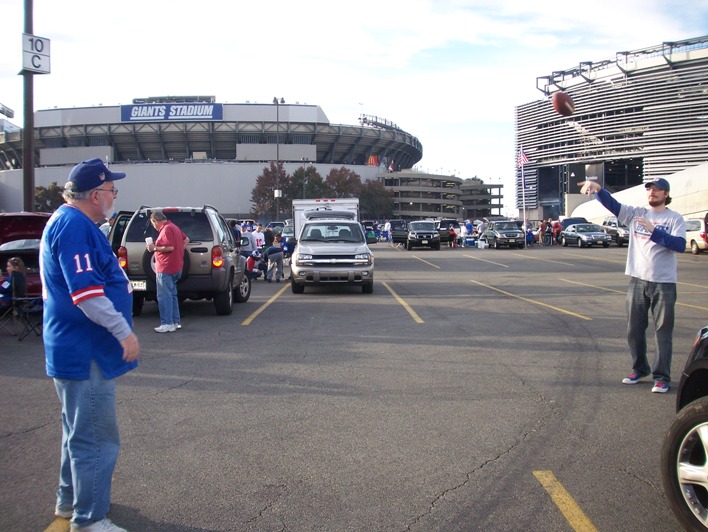
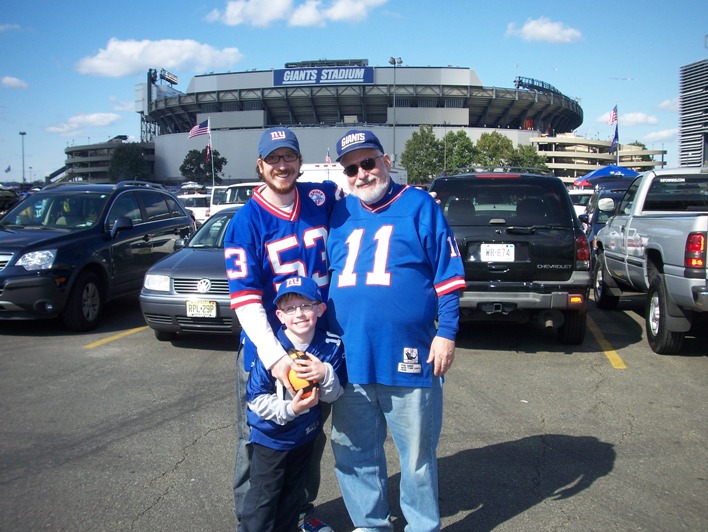
And that, I'd argue, requires more of an investment, more of an effort than being a baseball fan does (and I am a baseball fan). It requires more because it forces us to study, to be informed in advance of the next contest. It requires more because the individual games mean more, and because the games take more out of us. A bad Giants loss can take me several days to recover from. A season-ending loss can take months. Years, even. As a season ticket holder who gladly braves rain, snow, and single-digit wind chills (do baseball fans do that?), I think it's safe to say I'm committed (or should be committed). If Mr. Leitch disagrees, I invite him to plead his case at our next five-hour tailgate, provided he doesn't mention Yadier Molina.
He can even bring his dad.