Showing posts with label Dave Anderson. Show all posts

My Night In the Giants Stadium Press Box

Friday, October 29, 2010 |

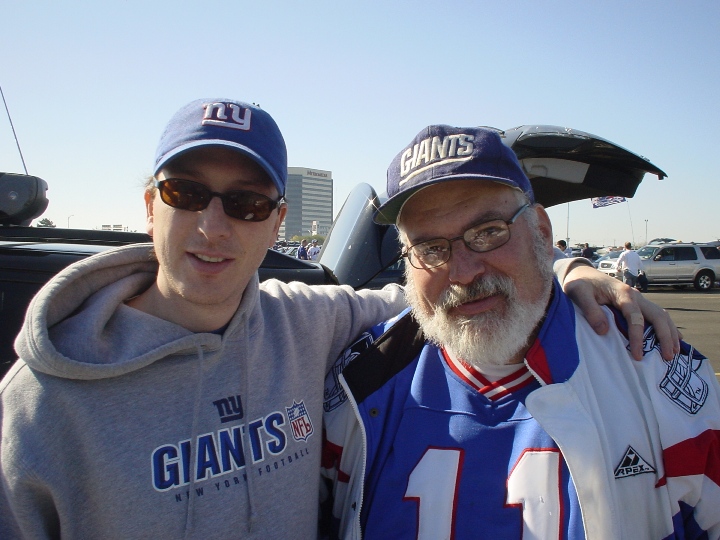
Giants Stadium may be gone, but I still can’t shake its memory. The more familiar I get with its shiny new replacement, the more I feel its presence. Giants Stadium hosted more NFL games than any stadium ever has, and in attending something in the neighborhood of 200 of them it became my treehouse. For 27 years, it was a place where my old man and I could go to get away from whatever else was happening in our lives and lose ourselves in the frenzied company of 80,000 mostly anonymous friends. 

I’ve been thinking a lot about Giants Stadium lately, and especially today, because it marks an anniversary of sorts. One year ago today I got my first and last glimpse at the Giants Stadium press box.

There was a time in my life when my greatest desire was to sit in that press box, covering the football team I loved. It was a dream that, as a teenager, I dreamed nightly. As the sports editor and, later, editor-in-chief of my high school's newspaper, I mimicked the reporters and columnists that covered the Giants for Newsday and The New York Times, the two papers that were delivered to our Long Island home every day. I studied their ledes, their styles, hoping they'd rub off on me. It was only a matter of time, I figured, until I'd be covering the Giants myself, "Scoop" Weinstein rubbing elbows in the press box with Dave Anderson and Bob Glauber.

Before I ever stepped foot on campus at The University of Michigan, I'd already sent all of my clippings to the sports editor at The Michigan Daily, a sharp young fellow who has since gone on to become a columnist of some renown at the Detroit Free Press and Sports Illustrated. When I finally met him in person, he thanked me for my frequent mailings by promptly dispatching me to cover a women's cross country event. Later that year, while I was pledging a fraternity and very nearly failing out of school, he allowed me to report on women's softball. These were hardly the beats I’d envisioned covering in my fantasies, but it hardly mattered. By that point, all I was truly interested in was drinking beer and playing Madden until my thumbs were sore. I was hardly ready to cover Michigan football, basketball or hockey, and it showed. By my sophomore year, I wasn't covering anything at all.

My life took a number of twists and turns after that, but eventually I found my way back to sportswriting. Through this blog and my work as a book editor, I even became acquainted with a few guys working the Giants beat. To a man, they all told me not to envy them, stressing that the life of a newspaper beat reporter is a lonely, generally unstable existence. Still, while at the stadium on Sundays I'd often find myself looking over my left shoulder and up at the press box, wishing I was up there with them.

Last fall, opportunity knocked when the fledgling United Football League announced, much to my surprise, that it had scheduled a game at Giants Stadium. Though I'd never actually applied for a credential, I knew the Giants would never issue me one, as is their general policy with bloggers. But the UFL? Who was the UFL to deny anyone anything? So I sent a letter to the UFL's director of publicity on some phony letterhead I created in five minutes using MS Paint, requesting a media credential for the epic showdown between the New York Sentinels and the California Redwoods scheduled for the evening of Thursday, October 29th. A week or so later, after a friendly follow-up email, a credential was granted.

The game, I'd later learn, would be broadcast on Versus, announced by Dave Sims and Doug Flutie. Former NFL star Simeon Rice was suiting up for New York, as were a few other recognizable names including wide receiver Koren Robinson (the ninth overall pick in the 2001 NFL Draft) and quarterback Quinn Gray, formerly of the Jacksonville Jaguars. John David Washington, son of Denzel, would represent the Redwoods. It was to be a star-studded affair all around.

Because I do not own a car and at that time did not possess a valid driver's license (a story for another time), I took a New Jersey Transit train to Secaucus Junction, where I caught a shuttle bus bound for the Meadowlands. Though the bus had a sign bearing the words "Giants Stadium" taped to its windshield, I began to question whether or not I had boarded the right one after only six other passengers climbed on board. When, roughly thirty minutes later, the seven of us arrived at the stadium, the parking lot was essentially empty. Never before had I see it so deserted before a game, and we often arrive at Giants games five hours prior to kickoff. It was, for lack of a better word, eerie.

I made my way through the lot and to the press gate, where my credential was waiting for me. It allowed for both press box and locker room access, but not field. I rode the elevator up to the press level which, constructed in 1996, was the newest structure in Giants Stadium. After waving my credential at an indifferent member of stadium security I was welcomed to a better-than-decent catered buffet, which included dessert and as many cans of soda as I could drink. The spread included baked ziti, roasted chicken, scalloped potatoes and salad. The press box dining room, however, much like the bus and parking lot had been, was sparsely populated. I could have gone back for a tenth helping and nobody would have said a word. Heck, I probably could have taken a whole chafing dish over to my table.

The local sporting press, I can only assume, was more interested in covering the minor event being held 15 miles east that night at Yankee Stadium—Game 2 of the World Series. AJ Burnett was facing off against the Phillies’ Pedro Martinez. Because the Phillies had taken Game 1 in the Bronx behind a masterful, complete game pitching performance by Cliff Lee the night before, many felt that this was a “must win” game for the Yankees, and I guess “must win” World Series games attract more media attention than Thursday night UFL games do, even when they feature Simeon Rice. I know this because the Yankee game was being shown in the press box, and more reporters were watching the television than the game on the field. Who could blame them? The product on display was, to be kind, of dubious quality.

Looking out through the massive glass encasement of the press box, I quickly ascertained that the rest of the tri-state area was glued to their TV sets at home, because nobody was in the stands, either. I mean nobody. At the time, I tweeted that I estimated no more than 500 people were in the building, including the players, coaches, event staff and the assembled media. The league announced attendance of 10,318, which was ludicrous. I had seen more fans gathered in the old gym at Hofstra, where the defunct USBL's Long Island Surf used to play. I’m fairly certain I’ve also seen more people waiting on line for Shake Shack at CitiField, or climbing out of a car at the circus.

For what it was worth (and it wasn’t worth much to many), the Redwoods won the game, 20-13. Gray was awful, Rice and Robinson non-factors. I don't even think Washington played. For the Sentinels, it was their third loss in a winless inaugural season that would turn out to be their only season. Shortly after the six-game season ended they packed up, moved to Hartford, and renamed themselves the Colonials.

For the Redwoods, it was their second win in what for them would be a two-win season. Both wins came against the Sentinels.

For me, the game was immaterial, though. I spent the better part of the first half tinkering with a blog post that had nothing whatsoever to do with the game and everything to do with the death of Giants Stadium. Up in the press box, I took the opportunity to experience the stadium from a perspective I’d never been afforded, and which nobody would ever be afforded again after December. I wanted to see what I’d been missing all those years, and to live, for one fleeting moment, the life I’d once dreamed of. And after doing so, I left the stadium exhilarated.

Because I couldn’t risk missing the shuttle back to the city, I did not venture down to the locker room after the game. Instead I packed up my laptop, said goodbye to the kindly reporters I had met and exchanged business cards with, took one last look around, and headed out across the vast expanse of black asphalt towards the bus.

As is the custom, there was no cheering in the press box that night, though a few scribes delighted in the results of the baseball game, a 3-1 Yankee victory. Unfortunately for the UFL, there was also no cheering of any kind anywhere in the vicinity of Giants Stadium, either. This begged the question: If a pass falls incomplete, repeatedly, in an empty stadium, does it make a sound?

The answer, to the consternation of Versus, is no, but for me it’s had a reverberation. One year to the day later Giants Stadium is gone, the Sentinels are in Hartford, and the Yankees are watching the World Series on television (unless, of course, they’re Cablevision customers). But me, I’m writing this blog, writing two columns a week for MSG.com, covering the team I love, and inching closer to that dream deferred.

Watch those elbows, Glauber.

Charley Conerly: December 3, 1956

Monday, July 7, 2008 |


I'm turning thirty-three this week. 

Facing that formidable round number, immortalized by such Giant "greats" as George Adams and Delvin Joyce, I've come to the sobering realization that I'm now older than all but four of the eighty-one players the Giants will bring to training camp this summer: Jeff Feagles (42), Amani Toomer (34), Sam Madison (34), and Renaldo Wynn (34). I've only got two months and a day on Sammy Knight, and he's closing fast.

Thirty-three certainly ain't what it used to be.
By the time my old man (the original Bluenatic) was my age, he was already married with two kids, had a house in the suburbs, two cars, and was seven years removed from the completion of his military obligations. He was, by all accounts, a legitimate adult in the world; mature, regardless of what my mother might say to the contrary.

But me, I'm still a work in progress, which means it's a good thing I'm not an NFL player.


In the NFL, thirty-three is an age at which many players retire. Some manage to hang on for a few more seasons, but the odd Bruce Matthews or Darrell Green aside it's the rare NFL player who makes it past thirty-five these days. My childhood heroes, Lawrence Taylor and Harry Carson, retired from pro football at age thirty-four and thirty-five respectively. Defensive stalwarts Leonard Marshall, Carl Banks and Jessie Armstead all hung them up at thirty-three exactly, several years past their primes. Rodney Hampton and hundreds more never even sniffed thirty; some because of injuries, some because of performance, and some because they just couldn't get their shit together.

Needless to say, it's a young man's game.
And by the time former Giants quarterback Charley Conerly was thirty-three, he was ancient. Or at least he looked ancient; hardly the type likely to blend in with my peer group.

"Chuckin'" Charley became the first of nineteen identifiable New York Giants to appear on the cover of America's preeminent sports weekly, Sports Illustrated, when this issue hit newsstands on December 3, 1956. The Giants were eighteen years removed from their last championship at the time, and hadn't been to the playoffs in six seasons. But behind the inspired play of their fearsome defense and Pro Bowl offensive stars Frank Gifford and Kyle Rote they won six of their first seven games to open the season. And by the time the rival Bears visited Yankee Stadium in November, three days after Thanksgiving, Sports Illustrated dispatched reporter Tex Maule and photographer John G. Zimmerman to the Bronx to cover the game and to capture the veteran quarterback that had led the upstart Giants to the top of the NFL's Eastern Division.

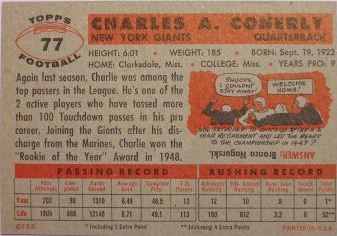
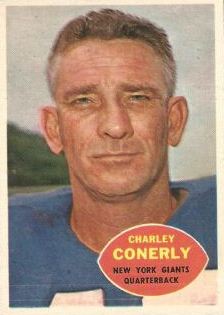
There is some conflicting information on the subject of Conerly's exact age at the time. In his story's second paragraph, Maule reports that Conerly is thirty-two years old. Yet Conerly's 1956 Topps card contradicts Maule's report by listing his birthdate as September 19, 1922, making him thirty-four at the time of the photo shoot. And the usually reliable data compilers at pro-football-reference.com say "Chuckin'" Charley's actually a year older than that, listing September 19,1921 as the Mississippi native's born on date. Wikipedia, databasefootball.com, The College Football Hall of Fame and The Mississippi Sports Hall of Fame all agree, which leads me to believe that it's accurate. But whichever is true--whether Conerly was thirty-two, thirty-four or thirty-five in that photo--one thing that's not in question is that his appearance suggests that of a man significantly older than he actually is. And really, it's all in his eyes.

Look into them. They are eyes that reflect the calculated confidence of experience. Eyes that know things, that speak of an innate toughness borne of challenge. They are not eyes that are surprised by things, that convey even the slightest uncertainty of purpose. No. These are eyes that have seen the kinds of battles that make the violent skirmishes of the gridiron seem trivial by comparison.

Conerly
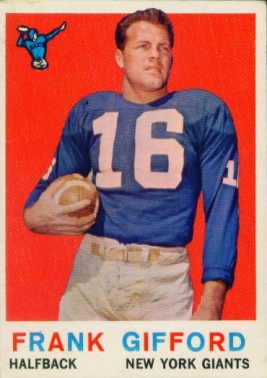
served four years with the Marines in the Pacific theater during World War II, achieving the rank of corporal. It was an experience that affected him deeply. "He hardly ever talked about the war," longtime roomate Frank Gifford told Dave Anderson of The New York Times*, "but he was in a few island invasions. He once had his rifle shot out of his hands."

After beginning his collegiate career at the University of Mississippi in 1942, Conerly returned to campus after the war a different man and a different player. He earned All-SEC honors as a single-wing tailback in his first year as a starter, 1946. One year later he'd be selected to the All-America team and finish fourth in the Heisman Trophy voting after setting NCAA single-season records for completions (133), passing yards (1,367) and consecutive passes without an interception (61) while leading the Rebels to their first bowl birth in twelve seasons and their first Southeastern Conference title in school history.

By the time Conerly got to New York as a seventh round pick in 1948, the Giants were still reeling from the gambling scandal that cost them not only the 1946 NFL championship but also their starting quarterback, Frank Filchock, and reserve back Merle Hapes (who preceded Conerly at Ole Miss) to suspensions. The Giants had won only twice in 1947, their 2-8-2 record the worst in Steve Owen's twenty-three years as Head Coach.

With Conerly under center, the Giants improved (marginally) to 4-8 in 1948. But he finished second in the NFL behind All-Pro Sammy Baugh both in completions and passing yards, third in passing touchdowns behind Philadelphia's Tommy Thompson and Baugh, and at the end of the season Conerly was named the league's Rookie of the Year. He topped that with his second straight 2,000-yard passing performance the next season, improving the Giants record by two more wins before breaking through with ten wins, an Eastern Division title, and a Pro Bowl selection in 1950. And beyond that, Conerly's rugged play earned him a reputation throughout the league for being one of its toughest competitors.


"He played one whole season, '52 or '53, with a shoulder separation," said Gifford.

Listed at six feet even and 185 pounds, Conerly was tiny by today’s standards. In today's NFL he’d be lucky to play cornerback at his size. But by 1956, when Sports Illustrated came calling, he had long since established himself as one of the top quarterbacks in the league. Remarkably, at the end of the season Conerly was voted to his second (and last) Pro Bowl, without having started even one game.

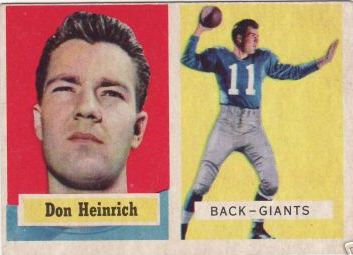
In an experiment conducted for much of the 1955 season and all of 1956, Head Coach Jim Lee Howell and his bright young offensive assistant, Vince Lombardi, used the Giants number two quarterback, Don Heinrich, to start off games. Lombardi would send Heinrich in with a list of plays that, according to Maule, were "designed to test the reactions of the opposing defense so that when Conerly replaced him—usually in the second quarter—he could probe at the obvious weaknesses."

"You don't see much of a game when you're in," Conerly told Maule. "You're looking for the guy you're going to pass to or the guy you're making a hand-off to, and you don't see much else. I guess I wouldn't even recognize half the guys I play against in a game if I saw them on the street afterward. They're just a blur when they are coming in at you, and you don't look at them again until you come out of the huddle. Then they are uniforms in a defense and you don't see faces, just the defense."

Conerly studied the Bears defense from the sidelines for three quarters on November 25, 1956. Though the Giants only managed a tie in that game, Conerly's study and Lombardi's imaginative gameplan resulted in a forty-seven point offensive explosion thirty-five days later in a Championship Game rematch versus the Bears. The score was 34-7 at halftime, and Conerly added two second half touchdown passes (to Rote and Gifford) punctuating the victory to the joy of the 56,836 fans in attendance at Yankee Stadium.

"
I got most of the accolades that year," Gifford--the league MVP in 1956--told Anderson, "but we knew who got us there."

Yet despite Conerly's and Gifford's best efforts, neither could get the Giants there again. Nobody could for another thirty years. Instead, the Giants followed up their amazing triumph in 1956 by losing five of the next seven championship games and then missing the playoffs for seventeen consecutive seasons.

The 1957 season included an undefeated November and a 7-2 record before consecutive losses down the stretch to San Francisco, Pittsburgh and Cleveland derailed their playoff hopes. But Conerly and the Giants rebounded in 1958 with nine wins and a shutout of Jim Brown and Cleveland in the Eastern Division Playoff, setting up a championship showdown with the Baltimore Colts in what would later be known as "The Greatest Game Ever Played."

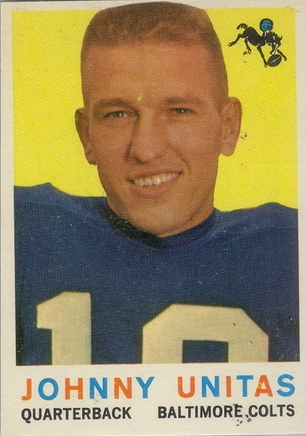
Conerly's fifteen yard touchdown pass to Gifford early in the fourth quarter could have (some believe should have) won the title game in regulation, had it not been for the heroics of the opposing team's quarterback, twenty-five-year-old phenom Johnny Unitas, and an unfortunate spot and measurement on the part of the game officials.

Driving late in the fourth quarter and in a position to run out the clock, the Giants faced a critical third and three on the Colts forty-three yard line. Gifford swept left. With most of the Colts defense reading pass, only future Hall of Fame defensive end Gino Marchetti stood between Gifford and the championship-clinching first down. Marchetti tackled Gifford near the marker as teammate Eugene "Big Daddy" Lipscomb piled on, accidentally breaking Marchetti’s ankle in the process. After Marchetti was taken off the field on a stretcher, the 64,185 anxious Giants fans packed into Yankee Stadium held their collective breath as referee Ron Gibbs spotted the football. They nearly rioted when the subsequent measurement found that Gifford had been stopped inches short of the first down.

To this day, Gifford (now seventy-seven years old) is convinced that he made the first down. He has even made the outrageous claim (in Mark Bowden's new book, The Best Game Ever) that referee Ron Gibbs came up to him after the game was over and admitted that he had blown the call. That confession offered Gifford little consolation then and offers even less now, however, as the Giants were forced to punt. With just under two minutes to play and starting from their own fourteen yard line, Unitas calmly drove the Colts down the field, finding Raymond Berry (another future Hall of Famer) three times on the drive for sixty-five of Berry's astonishing 178 total receiving yards on the day, setting up Steve Myhra (who had had played nearly the entire game at linebacker after Leo Sanford was injured on the game's second play) for a chip-shot field goal to send the game into the NFL's first sudden death overtime.


I think we all know what happened after that.

"Chuckin'" Charley wasn't finished, though. In 1959 Conerly, then thirty-eight years old (or was he 37? 35?), was the N.F.L.'s top-ranked passer and was named the league's Most Valuable Player by the Associated Press. But the Giants lost their title game rematch in Baltimore, 31-16, as Conerly was again outplayed by the amazing Unitas.

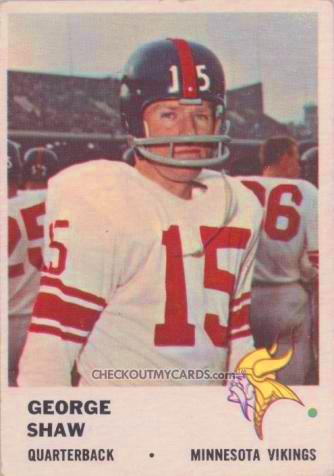
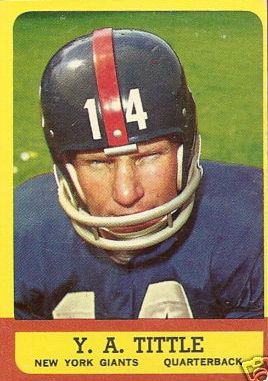
With his production waning in 1960, Conerly found himself sharing time with newcomer George Shaw, the former number one overall pick in the 1955 NFL Draft who had been Unitas’ backup in Baltimore the previous four seasons. The following year--Conerly's last--the Giants brought in thirty-five year old Y.A. Tittle from San Francisco to replace him as the starter. Without as much as a grumble, "Chuckin'" Charley sat behind Tittle (playing sparingly) for that one season before hanging up his spikes and heading home to Mississippi, where he later opened up and operated a successful chain of shoe stores.

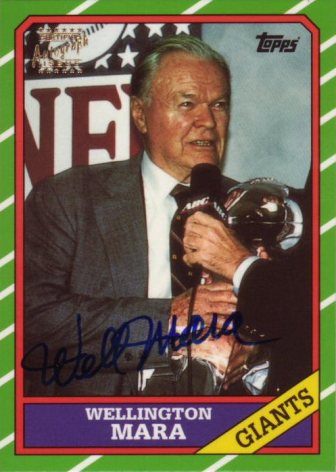
"Unlike many of today's players [would have], Charley never complained when Tittle came over," said Wellington Mara, the late Giants' co-owner. "He didn't ask to be traded. He didn't ask for anything."

Instead, Conerly understood the truth of his situation. "If you win," he said, "you're an old pro. If you lose, you're an old man." 
 

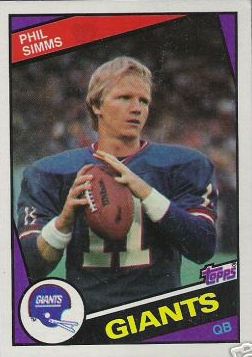
At the time of his retirement, Conerly held the franchise records for career touchdown passes (173), completions (1,418), passing yards (19,488) and passing attempts (2,833).* Today, forty-seven years after he played his last game, Conerly still ranks second only to Phil Simms in both career passing yards and touchdown passes. Despite having thrown 1,814 more career passes than Conerly, Simms only threw twenty-six more touchdown passes than "Chuckin'" Charley did over his fourteen years in blue.

And though his playing days were behind him, Conerly continued to appear regularly in Sports Illustrated for the next twenty or so years, his grizzled image spread across the pages of the magazine as one of the very first Marlboro Men, America's archetypal twentieth century tough guy. Fitting.

Conerly died on Valentine’s Day, 1996, at the age of seventy-four, cruelly, of heart failure. Just three weeks earlier, Dave Anderson had included him in a list of eleven players deserving of Hall of Fame enshrinement. Of those eleven, seven still await their call from the Hall. Conerly once came within two votes of being elected, but, Anderson wrote, “unfairly, he was somehow forgotten.”
 
"Charley is the best player who is not in the Pro Football Hall of Fame," Mara said shortly after Conerly’s death. "He has better numbers than some quarterbacks who are there."
 
"When I got in, I was embarrassed to be there when Charley wasn't," Gifford added.


 *     *     *

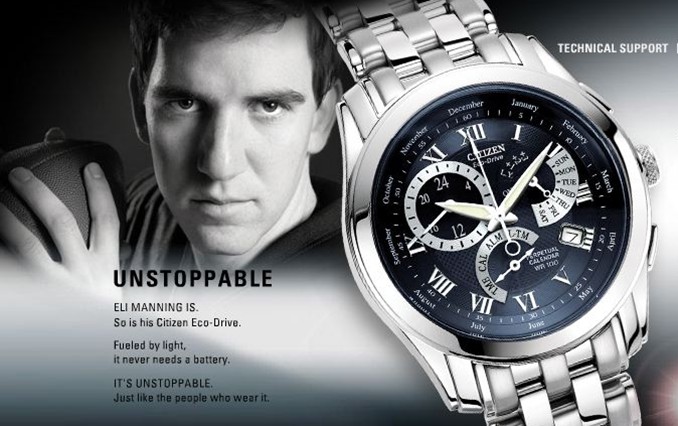
Years later, another Ole Miss quarterback by the name of Eli Manning would twice win the Conerly Trophy (2001, 2003), awarded each year to the best college football player in the state of Mississippi, before leading Conerly's New York Giants to a championship of his own.

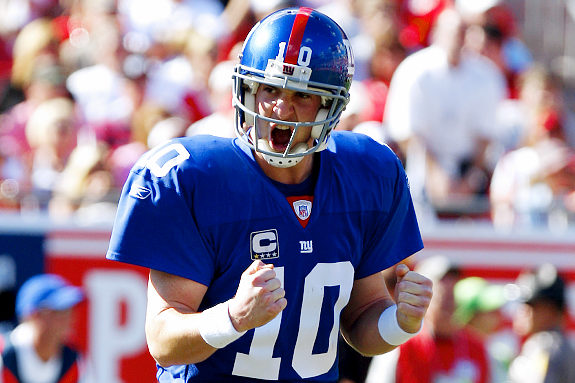
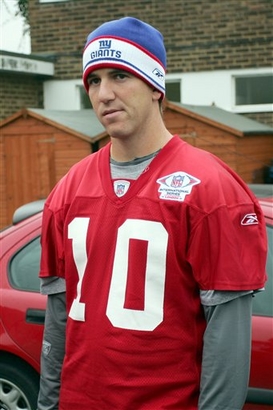
Still a baby-faced twenty-seven-year-old, Manning, too, knows a thing or two about playing with a separated shoulder. Through four seasons as the Giants starter he has proven himself to be one of the most durable quarterbacks in the league, having not missed a single start in that span despite being sacked ninety-three times. But unlike Conerly, whose stare was possessed of an intensity that could melt a glacier, Eli's going to have to work a bit on selling his "serious face." He's significantly more believable when he goes to his trademark "aw shucks face" or even his "pumped the fuck up face." Hell, anything's more believable than his "tough guy face."

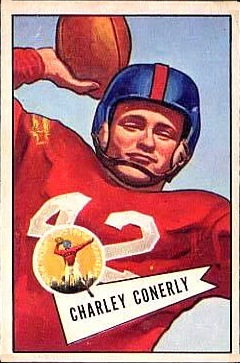
Give the kid some time, though. Conerly was just a rookie when he was Eli's age (or was he?), and it didn't take long for him to go from this to this. A few more rollercoaster seasons in New York and who knows? In five years Eli might look like Brett Favre.

And me? I'll just pretend like that old pro with the leathery visage and salt and pepper hair isn't six years younger than me.

________________________________________________________________________

* Sports of the Times, 2/15/96
* Charley Conerly's career stats