Tuesday, August 20, 2013 |


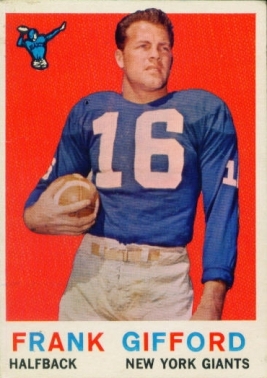
I recently had the chance to fulfill a life-long dream by interviewing Giants legend Frank Gifford for the Fall 2013 issue of Athletes Quarterly magazine, which I serve as a contributing editor. The version of the interview that runs in the magazine was edited down significantly due to space limitations, so I figured I'd post the full, unabridged 4,000-word interview here for the Giants diehards who might be interested. Enjoy.
* * *
MW: Believe it or not it’s been almost 50 years since you hung up your cleats, yet you still hold a number of meaningful records. First, you still hold the Giants franchise record for touchdowns scored, with 78.
FG: I find that kind of amazing, don’t you? We’ve had so many great players over the years—Tiki Barber and others [editor’s note: Barber ranks second behind Gifford with 68 touchdowns]. What it really says, I think, is that so many [of the Giants best offensive players] played at the same time, so they kind of divvied everything up. Back when I was playing, I was the one who got the ball once we got down near the goal line, and I think that’s part of the reason why the record has held up. But I kind of like it [Laugher].
MW: You also have the NFL record for touchdown passes by a non-quarterback, with 14. It’s unlikely, in my opinion, that this record will ever be broken.
FG: I don’t think anyone’s going to come out of the backfield to throw many touchdowns either. The game just isn’t like that anymore.
MW: But it was such an effective play for the Giants teams you played on. Why do you think the halfback option has kind of been taken out of today’s game?
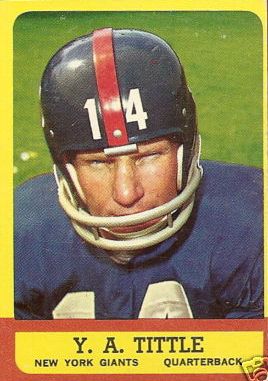
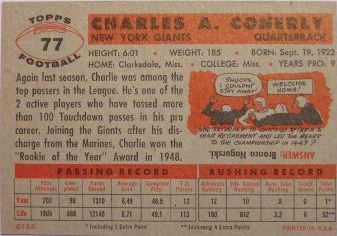
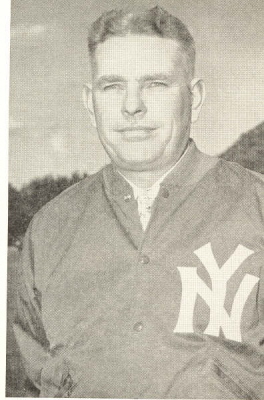
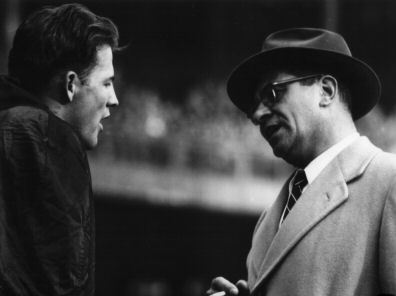
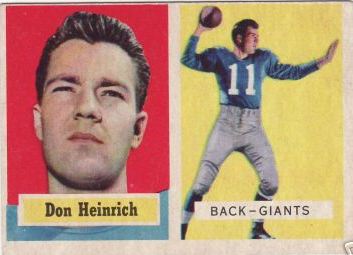
FG: I don’t know, really, other than that the quarterbacks today are such good passers and coaches don’t want to take the ball out of their hands. But that’s not the reason it was successful for us. I mean, Charley Conerly had a really good arm. Y.A. Tittle had a really good arm. Don Heinrich had a good arm. [Vince] Lombardi liked the play, though. When Lombardi came and took over with the Giants as our offensive coordinator, he wasn’t terribly happy with the quarterbacks we had throwing the ball, and he knew I was a quarterback at USC until my senior year, when I went to tailback. So I had played both positions and actually, I tried to return to quarterback with the Giants. But they didn’t have anyone at running back, so I just had to stay there. But today the quarterbacks are so good that there’s no question who’s going to throw the ball.
MW: Was the option pass something that you guys practiced a lot?
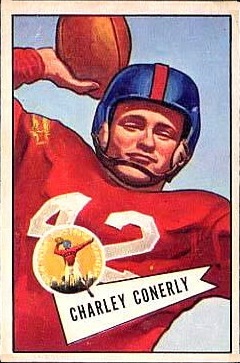
FG: Not really. I was the only one doing it, so maybe, at the end of a practice session, Lombardi would say, “let’s go to the 49 Option,” which is what we called it in the huddle. It was Brown Right 49 Option. Unless I might come out of the huddle and say [to our tight end], “Schnelker, take it short this time.” That’s just the way we did things then. I don’t think they do that so much anymore, but we had kind of a mutual agreement society in our huddle. Charley Conerly loved input. I’d walk into the huddle and it would be third and three or something and I’d say, “give it to me on 47 Slant.” And he’d say, “on three,” and we’d break; my old Mississippi buddy. [Halfback] Alex Webster would do the same thing. He’d say, “let’s try Trap 29,” and then [fullback Mel] Triplett might get in and Charley’d say “hush up.” But it was that kind of a huddle, and I don’t think you have too much of that today. Now they call everything from the sideline, or from up above.
 |
| L to R: Alex Webster, Charley Conerly, Mel Triplett and Gifford |
MW: Let me ask you
about Charley. I read a Dave Anderson story not too long ago which said that
when you got your call from the Hall of Fame, you were a little bit embarrassed
to accept it because Charley hadn’t yet been enshrined. Now 36 years have
passed, and Charley’s still not in.
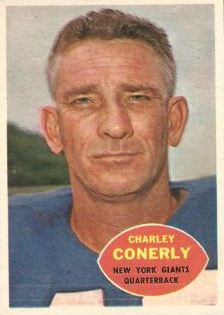
FG: For the life of me, I can’t figure it out. I mean, you look back and think about how, for a long time there, they used to split the quarterback duties. During the championship years, Don Heinrich would open up at quarterback. [Head Coach] Jim Lee Howell had a thing about that, and he wouldn’t let Lombardi change it. So Don Heinrich would be in there for about a quarter, and then in would come Charley. And I guess that had an impact on Charley’s numbers. And some of the voters who didn’t know Charley, they might’ve looked back and said, “well, why was he on the bench during the first quarter of games?” I really don’t know. I mean, I’ve campaigned myself for him and I think it’s wrong.
MW: So you still think he belongs?
FG: Yes. Absolutely he does. If I belong in, he belongs in.
MW: I think so, too. Maybe one day the Veterans Committee will give him another look.
FG: Oh, I think they will someday. It’s just too bad that they couldn’t have done it in his lifetime.
MW: The Giants teams you played on with Charley and later with Y.A. Tittle competed in six championship games in eight years, from 1956-1963, but you only managed to win one title, in 1956.
FG: Well, that first year, 1956, was when we made major changes offensively. It was the first year that I was the team’s key offensive player. And we treated the T-formation almost like a single wing, which is what I had played at USC. That was a big help, because when we’d shift from the T-formation into a single wing, I’d take the snap. The Giants coaches didn’t quite know what do with me, really. I could throw the ball. I could catch the ball. I could run the ball. I wasn’t the best any of those three things, but I had a few really good years, mainly because they gave me the opportunity to do those things.
MW: Was the 1956 team the best of those six teams?
FG: That’s hard to say. I thought we were really good in 62. 58 we were good, even though we lost in the sudden death game. I’d hate to have to pick it. I really would.
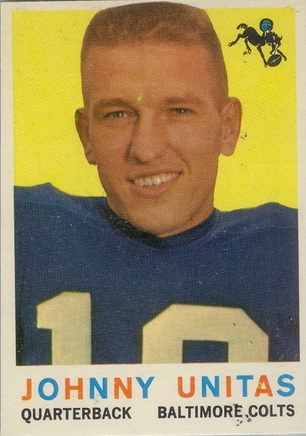
MW: Well, speaking of that sudden death game, I know you wrote about it in your most recent book, The Glory Game, but are you still convinced that you were the victim of a bad spot? [Editor’s note: In the final minutes of the 1958 championship game, with the Giants clinging to a three-point lead, Gifford carried on third-and-four from the Giants 40 and appeared to have made a first down that would have enabled the Giants to run out the clock. Baltimore's Gino Marchetti broke his leg on the play, though, and in the confusion the official marked the ball just short of the marker. As this was before the days of instant replay, the Giants had no choice but to punt. Johnny Unitas then led the Colts to the game-tying field goal in the closing seconds and then, in the league’s first ever sudden-death overtime, the winning score.]
FG: Oh yeah [Laughter]. But you know, I also understand it. I talked to the official, Ron Gibbs, and he agreed. Marchetti was moaning and groaning, “my leg! My leg!” and the officials were yelling “get off him! Get off him!” They marked the ball and I looked down at it and was like “good God”, because I wasn’t even thinking we didn’t get the first down. I knew I’d made it. No question. And the way I see it—the way I still remember it—I lost about a yard on the mark. And I just couldn’t believe it. And then years later the official admitted it. He said “you were right, Frank. We gave it a bad mark.”
MW: Wow. To think of the impact of that spot. I mean, it changed the course of sports history.
FG: It absolutely did. I mean, people look back at that game as one that kind of gripped the whole nation. It went into overtime and all and was picked up by satellite and sent across the country, and that was the first time we had been able to do that. It was a blend of a lot of things that really helped the game of pro football. And of course you had names like Unitas and Marchetti and other names that people had hardly heard of on the West coast, even, at that time, spread across the country.
 |
| With Vince Lombardi |
MW: One interesting
thing about your career is that it spanned the coaching careers of two true legends,
Steve Owen [the Giants head coach from 1931-1952] and Vince Lombardi [the
Giants offensive coordinator from 1954-1958].
FG: The legendary status for Steve Owen was established long before I arrived in New York. He had been there a long, long time. Owen’s Giants were strictly a single-wing team, and they had players like [Hall of Famer] Mel Hein and guys like that. But modern football came to the Giants with Vince Lombardi. And, later, Allie Sherman to some degree. But Lombardi came and brought in the T-formation, and that was the big change.
MW: Were there any similarities between Owen and Lombardi?
FG: Nobody liked Steve Owen. He was old school. He had a big cud of tobacco in his mouth all the time, dripping down his chin and onto his chest. As far as I was concerned, he wasn’t much of a coach. He really only cared about defense. He didn’t care about offense. He was old fashioned in the sense that he wanted the game to be a tug-of-war at the line of scrimmage. Lombardi, on the other hand, cared deeply about the offense. Perhaps too much.
MW: As a player who experienced, first-hand, a very serious head injury…
FG: Can we get this right, please? I’ve tried to do it many, many times, but it keeps coming up. It wasn’t a head injury. It was a neck injury. I got hit by [Hall of Fame Eagles linebacker] Chuck Bednarik on a crossing pattern. And I went back and snapped my head back on the field, which was kind of semi-frozen. And it stunned me. I wasn’t knocked unconscious or anything, but it did stun me. It wasn’t all that serious, really, but I was going to be out the rest of the season because the doctors didn’t know quite what to do. This was before they had CAT scans, you know, so I went to have my head X-rayed, and of course my head was all right. But I took some time off and then I came back and played three more years and made the Pro Bowl at a new position, wide receiver.
 |
| Hauling in a pass vs. The Cleveland Browns |
MW: That’s really
interesting, because it’s been widely reported and, I think it’s fair to say, commonly
believed that you suffered a severe concussion on that play. What was it that
happened to your neck?
FG: Years later, in the seventies, I started getting numbness in my arms. So [Giants team physician] Dr. [Russ] Warren sent me to go get a CAT scan of my neck. And when I had the scan, the technician working the machine said, “were you in a car wreck?” And I said, “no, not that I know of.” And it turned out I had multiple fractures of a couple of vertebrae in my neck. Had I continued to play and hadn’t taken that year off, I don’t know what might have happened. It probably would have been the same result, because the neck healed up on its own. It wasn’t like we put my head or neck in a cast or anything. There were fractures—not complete fractures, but enough that they left a calcium trace. And when they came up with the CAT scan, you could see them. It’s an interesting neck [Laughter].
MW: So the league, over the past few years, had made efforts to ensure greater player safety, specifically with regard to blows to the head. Do you think those efforts to make the game less violent are affecting its quality?
FG: No, I don’t. The players today are so much bigger, stronger and faster than we ever were. The collisions, back when I was playing, were rather violent. Many players would look to hit an opponent in the head, as a means of intimidation. So I think it’s a good thing that they’ve done, to get rid of that. I don’t think it changes the game in terms of its attractiveness or even its violence. I think it’s really a good thing. These guys are so big and strong that they’d really be hurting each other a lot more often.
MW: Do you think the league does enough to take care of its retired players, specifically the players now suffering from the effects of brain injuries?
FG: They really are trying. I’ve read a lot of things about what they’re doing, and at least it seems like they’re making a real effort. From the Commissioner right down, they’ve begun to shown great concern about some of the players. And there’s many, many more players now than there were when I played. I mean, we had twelve teams and now there’s what, thirty-two? Active rosters have increased from something like 35 to 53, so there’s just a lot more players to care for when they retire.
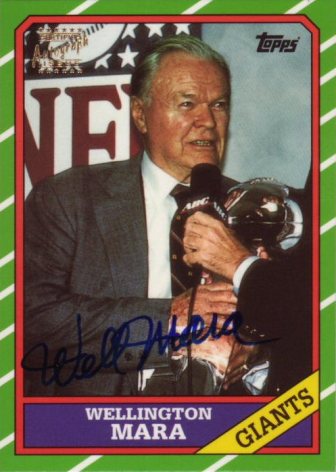
MW: I’d like to ask you about [late Giants owner] Wellington Mara. Can you talk about the significance of his friendship in your life and career, as well as his importance to the NFL?
 |
| With the late Wellington Mara at Mara's 1997 Hall of Fame induction |
MW: Television certainly helped increase your exposure, which led to a lot of opportunities for you to appear in advertisements. You endorsed a lot of products over the years, from Jantzen sportswear to Vitalis hair tonic. But one of the products you appeared in ads for was Lucky Strike cigarettes. And I’m wondering if, knowing what we now know about the adverse health effects of tobacco, you have any regrets about your association with Lucky Strike?
 FG: I do, but only in
the sense that when the Surgeon General’s report came out, I very openly quit
smoking. I quit the day the report came out. And that was the end of the
advertising, too. I was making more doing that—potentially, anyway—than I was
playing football. But that was the end of it. I said, “I’m not going to do it
anymore.” It’s been kind of lost in the pages of history, I guess, but that’s
exactly what happened.
MW: As a broadcaster, you were in the booth when Howard Cosell announced, during a 1980 Monday Night Football telecast, that The Beatles’ John Lennon had been assassinated. Can you tell me a little bit about what that experience was like?
FG: We were in the really early stages of the popularity of pro football, because we were the first to go prime time. And it was amazing how many things happened on Mondays. The John Lennon thing was really shocking to me, because I was a Beatles fan, as were my kids. And I just could not believe it. Howard wanted to go with it as soon as the news reached us, but I wouldn’t let him do it for quite a while. I knew we’d have to break it—we couldn’t sit on it any longer—so we finally did. But I made him hold it up until we called New York and got the news people on the line, and they confirmed that it indeed had happened. So nationally, we broke the story. Or rather Howard did, and, as he did in many situations, I thought he handled it beautifully.
MW: Most athletes, when they transition into the broadcast booth, become color commentators. And you did a little of that early in your career, too. But when you got to Monday Night Football, they had you doing play-by-play. Can you talk about the challenge of doing play-by-play, as opposed to color, on such a high-profile national broadcast?
FG: I’d gone into broadcasting while I was still playing. I was doing nightly news shows, reading prompter, and even on a few occasions sitting in for guys like [CBS news anchor] Bob Trout, one of the finest newscasters in the history of television. We worked as a team, so it wasn’t that I was inexperienced. I think most of the guys who go into broadcasting as color guys have never had the experience, professionally, of getting a countdown to commercial where you have to hit it exactly because you’re going national with it, but that was something I did on a routine basis almost every night. So it wasn’t that difficult for me to make that transition, whereas it would be for just a player walking off a football field. That player would be knowledgeable about the game of football—much more knowledgeable than the people he was talking to—but he wouldn’t necessarily be able to handle the intricacies of what goes on in the booth. How you get into commercials, how you get out. You’ve got a guy talking in your ear counting down, 10, 9, 8, 7 while you’re wrapping up a piece of action on the field, trying to end your call on the count of 1. But I had that background, and I had done it for many years.
MW: How would you characterize your relationship with novelist Fred Exley?
FG: [Laughter] Oh, wow. I remember someone telling me, “there’s this guy named Fred Exley who’s written a book about you.” And it was really bizarre, but that’s how I met him. I got this phone call. He turned out to me quite a guy. Tragically. He had all kinds of multiple problems, I guess. You hear about somebody writing a book and then you read the book and it’s like, what the hell? This guy’s been living with me! [Laughter] But I came to know him and admire him—he had a really brilliant talent—but he had multiple weaknesses, and I think that showed up a lot later on.
MW: Did you ever drink with him?
FG: I don’t really recall that, and if I did [drink with him] I bet I probably would.
MW: But you two became friends over time?
FG: We’d talk back and forth. I mean, he’d call me just out of the middle of nowhere. Sometimes he’d call and it’d be 3 or 4 in the morning or something in L.A. and I’d think, it’s late here, where the hell is he? [Laughter]
MW: I’ve always wanted to know what you thought of that book.
FG: I was amazed when I read it. I mean, the guy had been shadowing me and I had no idea. It’s kind of an eerie feeling when you think about it.
MW: Scary, even. I might have been a little bit afraid.
FG: Well, yeah. Because you never know. I’d probably be more concerned today than I was then because there weren’t as many kooks around. But later I really came to know him and he was really a wonderful person.
 |
| The Concourse Plaza Hotel |
MW: I read that during
the season, you and a lot of your teammates and your families used to live near
the Stadium at The Concourse Plaza Hotel. Can you describe what that experience
was like?
FG: You have to realize that we weren’t making the kind of money the players are making today. Some of those guys could buy the Concourse Plaza Hotel today [Editor’s note: The hotel is now a senior citizens home owned and operated by the City of New York]. When I was living there—I don’t recall exactly when it was, the mid-to-late fifties—I was only making fifteen, eighteen, up to twenty thousand dollars a season at most. And the Concourse Plaza Hotel was very expensive, even then. Prior to that, my first few seasons, I couldn’t even afford to live there. I lived downtown on the West side, at 100th and Broadway. And when I finally got a raise I decided it’d be a lot easier to be at the Concourse Plaza. You could get on a subway, because we used to like to come downtown a lot. That was before I was doing any broadcasting and the subway was right there between Yankee Stadium and the hotel. They were only like 3 blocks apart, and you could just go downstairs out of the lobby of the hotel and walk a short ways and get on the subway. It was elevated there at the time and went underground in Harlem. The Concourse Plaza was a wonderful place. We had a lot of friends there and we’d get together with them after a game and decide whose apartments it’d be. The better I did the better apartment I could have [Laughter]. I ended up hosting a lot of parties.
MW: Last but not least, do you have any advice for young athletes today?
FG: Oh, boy, I tell you. There’s so much pressure today from so many different sources. But first I think you just have to commit yourself to being the best you can be and not try to take shortcuts, as some people would like you to do and you might be tempted to do. I think the thing that really helped me was that I worked so hard in the offseason—I’d say almost as hard as I did during the season, when we were playing. And that enabled me to stay in great shape year round. If you’re going to play football professionally it takes a total commitment. It can’t be halfway. In professional football, especially today, I mean these guys are so good that if you’re going to play the game and decide that’s what you’re going to do, your commitment’s got to be one hundred percent.